


It may not come as a surprise that humans are flawed. We like to please people and be part of a tribe — to feel a sense of belonging. These are admirable traits but they can stand in the way of understanding each other. Like, really understanding each other.
Do as I say, not as I do
This was a phrase my dad would often remark when I called him out on something growing up. It used to frustrate me trying to understand these double standards that he held himself to. It seems that this flaw can also be observed in the world of research.
I was chatting with a research colleague, reminiscing on past research efforts, what we learned and the impact that it had on the respective projects. It was inevitable that at some point we would touch on a shared experience that’s all too commonly observed when doing research. Hearing someone say one thing and watching as they do something completely different.
He shared a particular example of how people generally share concerns about privacy and see this as important. But when undertaking some research the reality is that they give less shits than was first understood. This observation saved the company a tonne of time and money by not investing in something that in reality, was not needed.
I could also speak of countless times when people have described, in detail, how they would approach a task only to go about it in a completely different way.
People often share feedback or remarks based on what they think we want to hear as a safeguard against offending someone or entering into some sort of confrontation. This is less than ideal when you are trying to understand your users and customers.
Here comes the curve
What’s a good argument without an exponential curve of some sort? I appreciate there are many flavours in which to view this, but I wanted to find a simple narrative, so here goes:
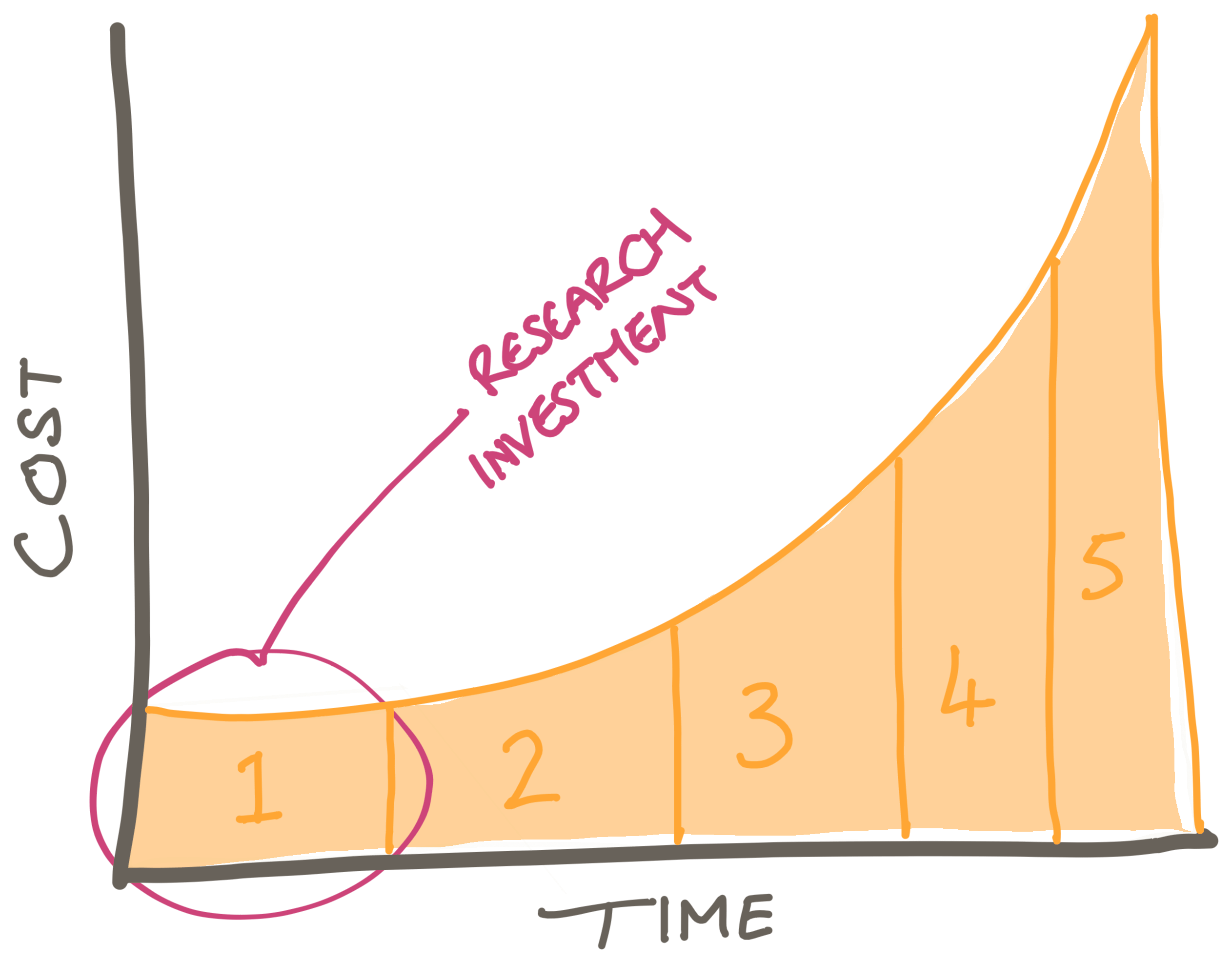
In some companies or teams research can often be seen as an overhead, a slow-down, or a “nice to have”. The reality is that research, done well, can save costs, prevent risks, and identify new business opportunities. It’s a — relatively small — investment that almost always guarantees returns.
Let’s take a look at each stage above in brief:
You run a research study that sets out to test some early assumptions. You test competitor products, shadow people, or run generative interviews. You prove the assumption wrong, gain an understanding of the real need and use that to drive the next stages of the project.
The team works on a prototype to respond to the problem. They work quickly and iteratively and test their ideas as they go — tweaking the details and ironing out some gotchas that were missed before.
Now things get serious and a larger team gets involved. They build the product following production-quality standards, rigorously testing and then launching the feature to thousands of customers.
Customer support articles are updated, sales teams alter their pitches, and the marketing team spends tens of thousands on advertising and publicity.
Customers adopt the feature, love it, stick around for the long term and share your awesome product with friends and family.
A real need was validated, tested, and launched to bring value to the customer and revenue to the company — win, win.
The alternative
You skip the first parts. Build a feature based on loose, untested assumptions, get the whole team involved, add a lot of code and processes and then — BANG! People don’t use your feature. Even worse, it frustrates them. It highlights that you don’t understand them and their needs, and they leave. Not only is this a bad situation to be in, you have also created a bunch of technical and process debt that will one day need to be unpicked — at an additional cost of course.
A quick look at the rollout of the Twitter check marks reveals how not to do things.
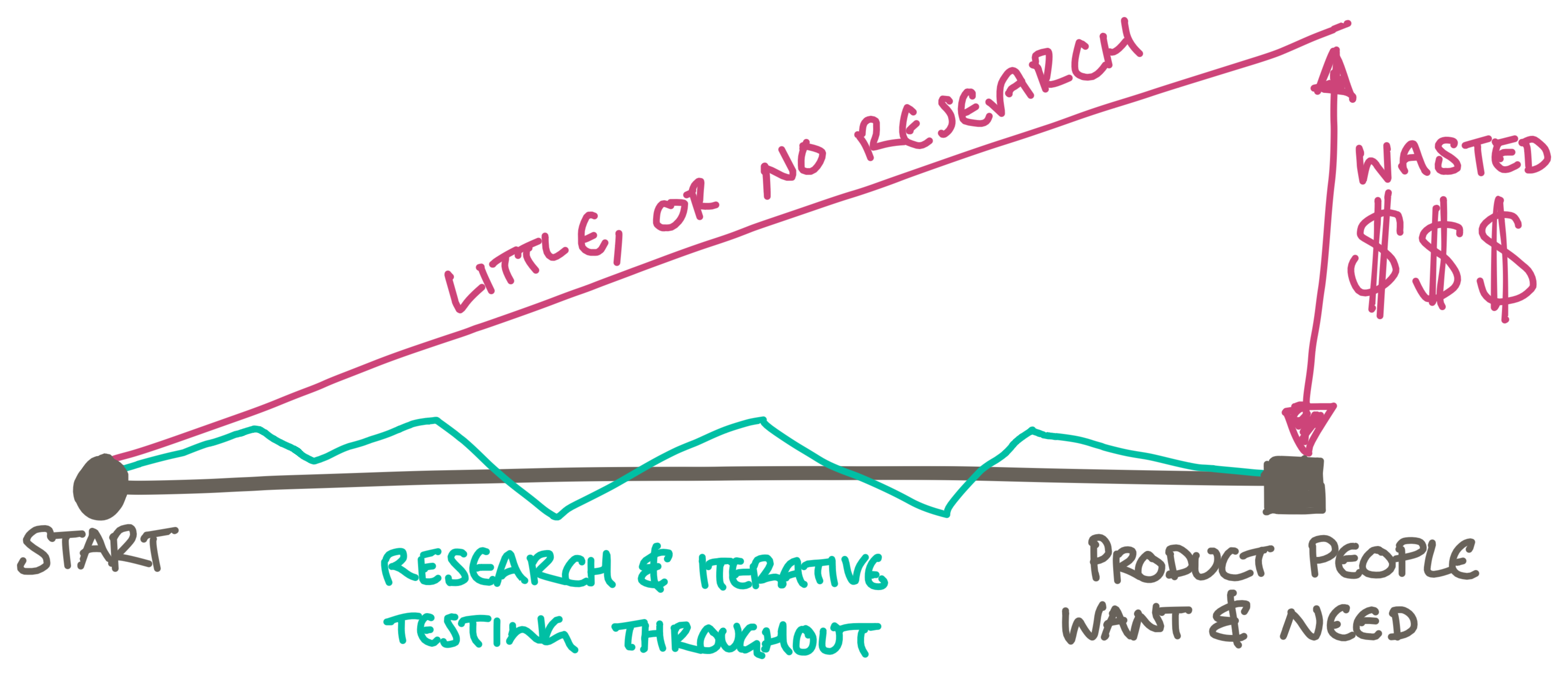
Simply being a degree or two off at the start can have a significant impact at the end of a project. Invest in research and pay attention to what people actually do, observe what they need, and give them what they want — not what they say they want.
This weeks playlist
So, on Sunday I dusted off my “aggressive” inline skates and set off down to the beach to stretch my legs and get the blood pumping. As a teen, I was big into the skate scene and would watch all the videos religiously. Aside from the tricks, the soundtracks were often epic.
I was elated to find this little gem of a playlist before setting off. Enjoy!