


Following on from my previous article, One Big Thing, shared back in February 2023, I’d like to report on some learnings and iterations made to that ritual since we started adopting it 3 months back. If you haven’t read it yet, go check it out for some context.
Most Important Things
After rolling out the One Big Thing ritual to the team, it wasn’t too long until that one big thing became more than…one. Was the system broken? Is it impossible to focus on just one thing? Short answer — no.
Having to decide between a few things and label one as the thing that matters for that week can pose a challenge. How was this resolved? The team would simply add the two or three things that they were working on which were big and important for that week. Does that mean that they are not focused? No. It simply reflected the reality of their weeks.
This gave me pause to consider if we were framing and discussing the week in the right way. I’d come across the concept of Most Important Things (MITs) in the past and considered rebranding our ritual to something more fitting. This week we kicked things off, and the early signs are good.
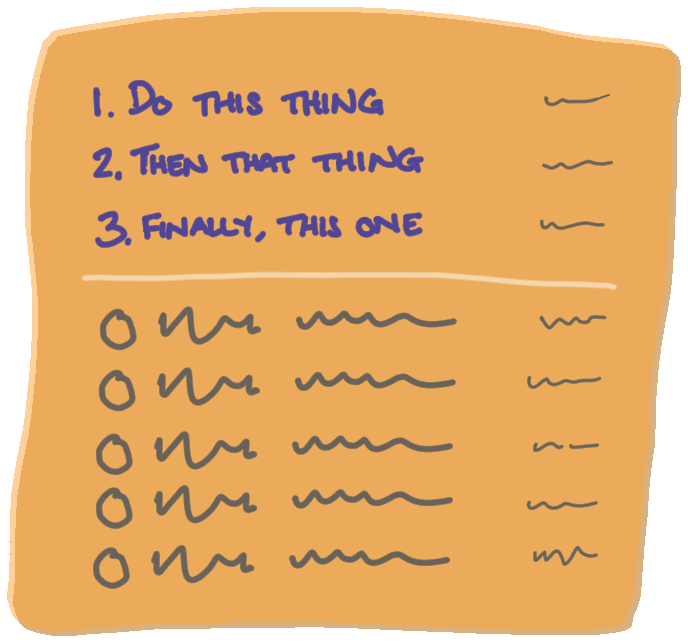
I’m not so sure about this
In addition to rebranding this Monday ritual, I’ve also explored adding some additional context to each “thing”. The first piece of metadata that has been added is a confidence indicator. What do I mean by that? Like most things in life, we can be sure of some things — like death and taxes — but we can’t be so sure about everything. This is perfectly OK.
What’s not OK is to misalign your expectations or those of others, when it comes to your confidence. If you strut into the week certain that you will smash all of your goals, that’s great. If you gently tip-toe into the week, unsure of what will unfold — that’s something worth talking about.
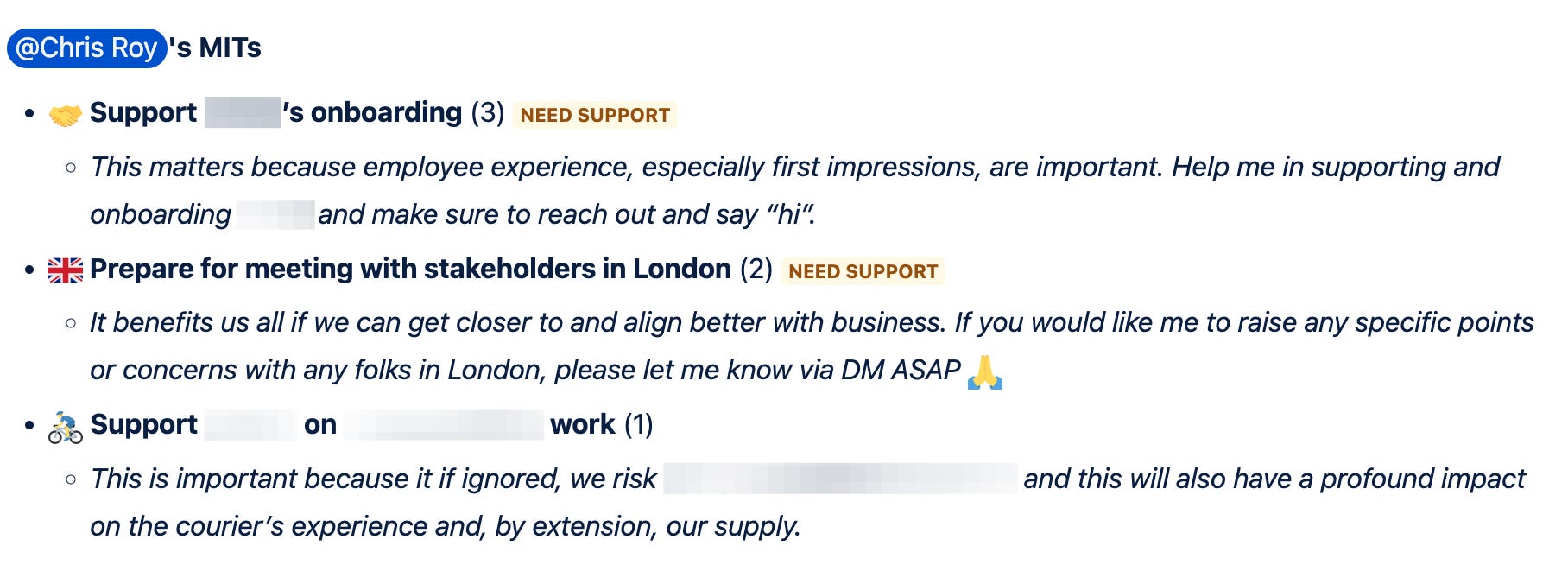
So, in addition to sharing what our MITs are for the week, we each share a confidence score alongside each. 1 being the lowest, 3 being the highest. I borrowed the thinking from the hill chart idea that I came across via the guys over at Basecamp.
Put simply, at position (1) you are staring up a hill, with no idea of what the journey to the top will look like, let alone what’s on the other side. When you reach position (2) you have gathered enough context and information such that you can confidently see the path ahead and can plan accordingly. Position (3) is the sweet spot. It’s that downhill acceleration to the finish line.
Not everything can be 3’s and that’s OK. So, if something is a (1) or a (2) you can signal to your peers that you have some doubts and that surprises may appear. It’s a micro-communication about how you are feeling about a particular goal.
On being explicit
Building on the metadata and additional context, we’re also trying to be much more explicit. Not, Snoop Dogg style. More for clarification. It’s simple…if you need help with something — say it. If you are blocked by something — say it. By just offering up that reminder, it helps the team to ask for help or to escalate something in good time reducing any last-minute surprises.
By having this ritual on Monday morning, we have plenty of time to rectify any challenges before the end of the week.
Why, why, why
Lastly, and probably most importantly, we now focus on the “why” of each MIT. For something to be the Most Important Thing for that week, it must have a good reason, right? I’ve never worked somewhere where I have had nothing to do, luckily. Staying busy is not the problem. Focusing on the right things is.
Going through the exercise of sharing why something matters is cathartic in the sense that you can hold up a mirror to any subconscious feelings of importance and look objectively at it to see how much it really matters.
Break it down
Adopting this new way of stating our focus gives each week a sense of purpose and divides what could be a 3-month project into smaller bite-size chunks. It trains our minds and our habits to seek out the work that matters, that has a good “why”. It makes it OK to put other things aside.
Leading by example, here were my 3 MITs for this week:
Be accountable
One of my colleagues, who is not a morning person by admission, told me once about how she would get up at 6 a.m. to go to the gym with a friend. Would she still go if it were not for her friend? No (she confirmed). So, how is this possible? She has an accountability partner. This is why we will do better when we form part of a class or when we know someone is expecting us to turn up. We don’t want to disappoint. Stating our MITs for the week creates this sense of accountability and allows others to ask about those things.
Given that I normally have my 1:1s with my team at the end of the week, I can take that opportunity to run a mini-retro and see how they got on compared to their plans. Doing this cyclical work of setting weekly objectives and checking in at the end of the week has been working wonders for me to stay focused and prioritize meaningful work.
As a manager, this also presents a great opportunity to learn and optimise each week versus waiting until mid-year or end-of-year review cycles when a lot of the detail often gets forgotten about.
Why not try this with your team and share some feedback
Powering this week’s thoughts…
Music plays such an important role when I am thinking, working, and reflecting. I also find it interesting to see what others are listening to. It's a gateway into an aspect of their personality. That's why I'd like to share, with each article, an artist or playlist that I have been listening to that week. Here's this week’s: