



Let’s start with the power of “no” 🙅♀️
Past experience truly is the greatest teacher. Looking back, I would always be the first to say “yes” to projects, “yes” to tasks, and “yes” to involvement in everything. It felt expected, it felt like the right thing to do. It was dumb. It simply added personal stress, meaning that all the impressing that I thought I was doing by saying “yes” was being undermined by my lack of time to deliver effectively on any one thing.
When asked to join a meeting, don’t fall into that trap and blindly accept it. First, question why this meeting is happening in the first place. If that’s not clear, walk away.
Meetings have become a default crutch when trying to address ambiguity, but simply gathering people together with no agenda and no goal in mind will likely not get us to clear resolutions. In fact, the more people you gather the more questions will likely arise.
If ambiguity is the issue that we’re trying to solve, what other ways can be explored to alleviate that problem? And how can we make it more long-lasting? Maybe people need better training, clearer job descriptions, or a clearer project outline. No amount of meetings can address these root causes.
Schedule thinking, not meetings 💭
If you work in the knowledge industry, sitting half-connected in a meeting is likely not the best use of your time. Your value likely comes from you applying your skills and doing work that achieves outcomes. Often, the only outcomes of well-structured meetings will likely be an action item list and perhaps some decisions made on topics.
Now that you’ve collected those action items and have the context that you needed, you need to find the time to do the actual work. One technique that I have started following — to great effect — is to look at the week ahead.
Before arriving in the thick of next week’s “forest”, take a look at it from a clearer vantage point—seeing from afar the clusters of meetings and the clearings of focus time. How patchy does it look?
Before people start to demand your time and you inevitably get pulled into yet another meeting, carve out some clearings in your forest for you. Those clearings are your focus time — protect them.
You may find that when people see your focus time that the meeting invites you would have received actually end up becoming a Slack message or an email that you can review and reply to in your own time.
Forcing yourself to value your own time will encourage others to respect it.
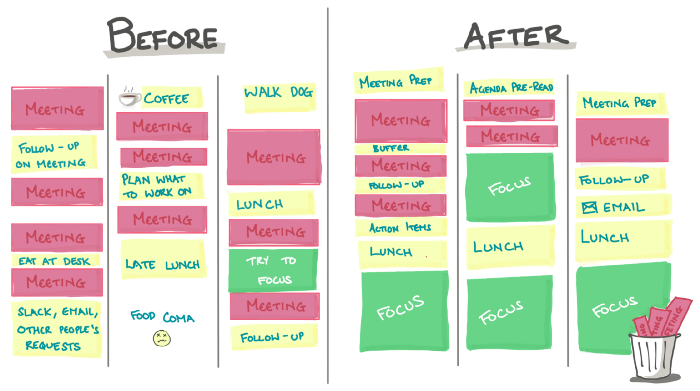
Another benefit of looking one week out is that it allows you to shift some of those meetings around. You’ve all seen it. The 30, 30, 30. Where you have one meeting, followed by a short break followed by another meeting. It can be hard to gather thoughts in-between meetings or prep for the next.
You are also switching from meeting to executing and then back to a meeting. This context switch is a killer. Personally, I prefer to bundle meetings. This way I can block out time before to prep for both, and then block out time for follow-up work afterwards. It’s even better if I can group the related meetings. For example, I run all my one-to-one meetings on Friday morning so that I can keep my head in the coaching and mentoring space.
These small shifts put you in control of your time and allow you to organise yourself in the way that works best—for you.
It’s nothing personal 😰
As humans, it’s likely that most days we experience some form of FOMO (Fear Of Missing Out). I blame social media mostly for this increased anxiety, but that’s for another article.
As a prospective meeting invitee, it can feel uncomfortable if you don’t get invited to that meeting. It’s reminiscent of the days at school when nobody picked you for the sports team. It sucked. Being excluded from meetings can feel similar, but it can actually be a blessing, depending on how you look at it.
Simply participating in a meeting does not guarantee that you will gain something valuable from it. I would argue that oftentimes a smaller group can work more effectively and, where needed, can follow up with a succinct update to those who need to be in the loop.
Likewise, as the organiser of the meeting, it’s your job to scrutinise that attendees list. It’s all too easy to add people — literally the click of a button.
What’s far harder is for the recipient of your request to review the agenda (you do have one, right?) decide if they are needed and then respond to your meeting request.
Vague is poison ☠️
Now that we have briefly touched on the agenda and some of the responsibilities of the organiser, let’s dive deeper. You see, meetings are not a chance to get together and chat—we have water coolers for that. As an organiser, you need to take the responsibility for setting the goal of the meeting and understanding its value — or another way to look at it — its cost.
We need to understand that meetings are a direct cost to the business.
When you start to see meetings through the lens of the cost your perception of them changes immediately. When you look around the table — or scan through the thumbnails in the call — you can start to quickly add up the cost. Imagine that everyone in the meeting is paid a modest $20/hour. A five-person meeting costs the business $100. Now, consider how many of those you have in a week and you can see how it all adds up. Keep in mind that this excludes the prep work, follow-up, and context-switching costs.
As the organiser, your first responsibility is to ensure that you have applied the Goldilocks principle to your attendees to ensure that it’s “just right”. But before you decide who needs to be present you need to understand why you need that meeting in the first place.
Take some brief time to set a goal for your meeting. What are the purpose and expected outcomes? Have you exhausted other avenues and a meeting really is the only way to solve that problem?
OK, great — time to craft your agenda. Be clear about what the goal is, what the talking points are, and how much time you are willing to allocate for each, being realistic of course.
With all of that clear, you can now turn to your org chart and see who can actually speak to those points and provide relevant input on the topic. It‘s also recommended to assign owners to topics, ensuring that they're clear on what’s expected of them before they arrive at the meeting. If there is any pre-work required ensure that it is requested clearly, and in good time.
One of the most offensive things you can do is send out a meeting to a large audience with no agenda. Don’t be that person.
Remember Parkinson’s law ⌛️
OK, so we need to meet — it’s clear. But for how long? If you’ve spent the necessary time to prepare and review the agenda, it should be clear how much time you realistically need. Once you have that time, chop it!
It’s very hard, if not impossible to estimate exactly how much time is required for discussion. There are so many variables at play. One thing is certain though — if you offer up 30 minutes to discuss a topic, it will take the whole 30 minutes. As Parkinson’s Law states — and as most of us will likely recognise — our work expands to fill the time we’ve allotted for its completion.
Try cutting that 30-minute allocation to 15 minutes and what you’ll likely find is that you stay on-topic, shelf any digressions and get to the point much faster. Having that added stress of a ticking clock can help us to focus on what matters (a feature that’s sorely missing from most meeting tools).
Having a visible clock during your meetings can drastically improve this commitment to the time, even if it’s simply referring to the time in your status bar or your watch sitting in front of you. Also, verbally calling out a countdown or leaving a message in the chat window: “5 minutes left, …, 2 minutes left, …” can really help people to stay focused and avoid digressing.
When allowed, topics will run over, you won’t get what you came there for and—guess what—you’ll likely need to schedule yet another meeting to get closure. Sounds terrible, right?
Like most things in life, practice here will help. It may feel uncomfortable at first but after a few tries, hopefully, you will start to see and feel the benefit of keeping everyone more focused.
The driver and the journalist ✍️
When you kick off a meeting, as an organiser you will likely be the driver. You’re the one who knows where we’re going, why, and how we get there. You should also be keeping an eye on the clock to ensure that we’ll arrive on time — though early is always best.
That being said though, it’s not easy to drive and take notes at the same time, so why not ask for a “journalist” to help out? Someone to document and record the findings along the way. Someone to record the decisions and action items in a clear and structured way — with owners and deadlines.
Ideally, you will use some sort of tool to help you with the note-taking part. And, if you’ve been a great organiser you will have shared this with the attendees before or at the start of the meeting.
I also find that it’s a great practice to share your screen with the audience while taking notes. This does two things — firstly, it gives you something to focus on and follow and the visual aid can complement the spoken word. This can be especially useful in multicultural settings where misunderstandings are more likely to happen. Secondly, it allows all attendees to validate that what’s being said and what’s being captured match what they’ve heard.
Inviting attendees to police what’s being written gives everyone in the meeting a purpose which in turn will likely make them more engaged. If it helps, explicitly state who is who and what the expectation is from the driver, the journalist and the observers.
The good ending 🍿
OK, so we nailed the agenda, had the right people there to collaborate, and then…nothing.
How many times have you sat in a cinema, at the end of a movie, and thought “is that it?” Don’t leave your participants with that same feeling after your meetings. Ideally, a meeting should feel accomplished. It should feel like those involved have solved a problem, made a decision or clarified some next steps.
Running the discussion to the clock and ending with a hard cut stinks just as bad as those movies. Don’t do it. Try to leave some time at the end of your meeting to do a quick recap.
Hopefully, someone has been taking notes and sharing these on screen for others to follow. If so, now is a great time to do a final whizz through those action points. Do they all have clear owners? Do they have deadlines? Does everyone agree that these are the next relevant steps? You don’t need a discussion — just a thumbs-up agreement.
To close off your meeting, look for that closure that leaves your audience feeling good. Call out if you have reached the goal of the meeting, or not. If not, take that as a chance to learn. Either way, leave everyone to walk away more clearly than when they arrived — never the other way around.
Lastly, if you use some sort of RACI matrix (Responsible, Accountable, Contributor, Informed) and there are some people who need to be “informed” make sure that you, or someone, completes the task of following up to share the notes and summarise any key findings or actions. It can be best to share a link to a collaborative document where people are able to asynchronously review and add further comments if needed.
Give the gift of 5 🎁
Want to make someone's day? It’s really quite simple. That meeting that you invited them to — wrap it up early and say “there you go, five minutes of your time back”.
It may seem trivial but that 5 minutes could be a well-earned break, an extra cup of coffee or some fresh air before that person needs to dive into the next thing. In doing so, you are creating a culture of respect for each other’s time.
We are not robots, able to jump non-stop from meeting to meeting without breaks. The sooner we can recognise this, the better for everyone. You’ll get happier participants and the next host (if there’s another meeting) will receive more refreshed attendees.
Check the pulse 📈
Humans can be great liars — we invented the game of poker after all. Looking around a room can signal that people are interested and engaged. But maybe if you had everyone hooked up to a heart monitor screen that plots interest instead of heartbeats, it could be flat-lining.
The last thing you want is zombies in your meeting. One way to validate is to do a quick check-in at the end of a meeting or immediately after in a Slack thread or email. Timing is key.
Don’t ask someone if they felt the meeting from two weeks ago was useful. Our memory can drastically bend our perception of the past. Couple that with our need to feel a sense of belonging and avoid conflict and everyone will likely lie and say “yes, it was great!”
Instead, you want to tap into that raw emotion. Catching someone at the end of a meeting or immediately after will put them in the position of reviewing — at that moment — whether it was better to be in your meeting or if instead they would have been much happier and more productive with their head down, focused on some other piece of work.
Keep your pulse-check request informal and lightweight to make it super easy to answer. It goes without saying though, that for this to work, you first need to have a culture of openness and candid feedback. It doesn’t matter how or when you ask this question if your company does not truly value other people's input.
Stay accountable 😎
One key principle that stays true throughout this narrative is the need for clear accountability. Whether that be the accountability of the organiser to ensure the meeting has a well-structured and realistic agenda. Or the attendees who arrive are prepared and ready to offer their input.
If you are not clear on what you are accountable for, simply ask. If it’s not clear, then maybe politely decline that meeting.
Meeting cheatsheet ☑️
Reduce the need for meetings in the first place
Protect your calendar for your focus
Try to avoid the feeling that you need to be involved in every meeting
Set a clear goal and agenda for your meetings
Review the cost of the meeting and choose attendees wisely
Try to reduce the time you think you’ll need
Do a quick intro to set the stage and align everyone on the goal
Clarify who is the driver and ask for a journalist if needed
Capture decisions and action points in real-time (ideally in a shared doc)
Leave space for a quick recap
Don’t feel the need to fill airtime — give people their time back
Follow-up with a pulse check to test a meeting’s real value
Be sure of your accountability, before, during, and after
Got any tips of your own when it comes to meetings? Feel free to share some comments 💬