


It was a warm summer afternoon in Bordeaux, France when I jumped on the call with Brian Lovin. Having been a long-time listener of the podcast, Design Details, I was eager to jump on a call and find out more about his upcoming project, Campsite.
But first, let's rewind
Before getting into why I am bringing up Campsite, let's first step back for some context. Back in the summer of 2021, I joined the tech department of a large European logistics company. We had a product design team of 11 and one UX researcher.
Being a B2B logistics company means that we lean heavily on operations. As such we have built many products and services to serve our expanding markets. Whilst expansion is a nice problem to have, it's not without its challenges.
As a growing design team, we would often find ourselves drifting off to the various corners of the business to help solve problems for our users and stakeholders. All good so far...designers solving problems sounds about right.
Pause and reflect
Solving problems in various corners of the business is adding value, but not if we are diverging and losing sight of our collective path. An admirable cultural aspect of our tech team is the ability to continuously reflect and ask ourselves how we can work better, and smarter.
As part of a standard feedback loop that is orchestrated across the whole org, the team are asked a number of questions to find out what’s working and what isn’t. Taking this feedback into account, one of the challenges we uncovered as a team was the feeling that we were drifting apart and working more and more in siloes. As each day passed, our ideas diverged and we lacked the overlap and collaboration that often happens in the earlier stages of a company.
Identifying the problem is always a great place to start, and the problem was clear. So, let's frame this as a good old how might we statement:
How might we, as designers, stay in sync with the latest work in the team without being overwhelmed with information?
Ceremonies
As with many design teams, we had our usual rituals. Two which are still taking place each week are our product design weekly and our critique sessions.
The weekly is a chance for us to share important updates with the team, have discussions together, or simply hang out, chat and have fun. Last year, the team also introduced a new "ice breaker" segment which has been a great way to get to know each other better and talk about life outside of work — an important detail when most of the team works remotely.
The critique on the other hand is more focused on sharing work and seeking feedback from peers. Whilst this is a great ceremony which brings a lot of value it's often just one designer who takes the stage each week. Put that way, it would now take us 16 weeks — 4 months — to get through all of the Product Design and UX Research team.
In steps Campsite
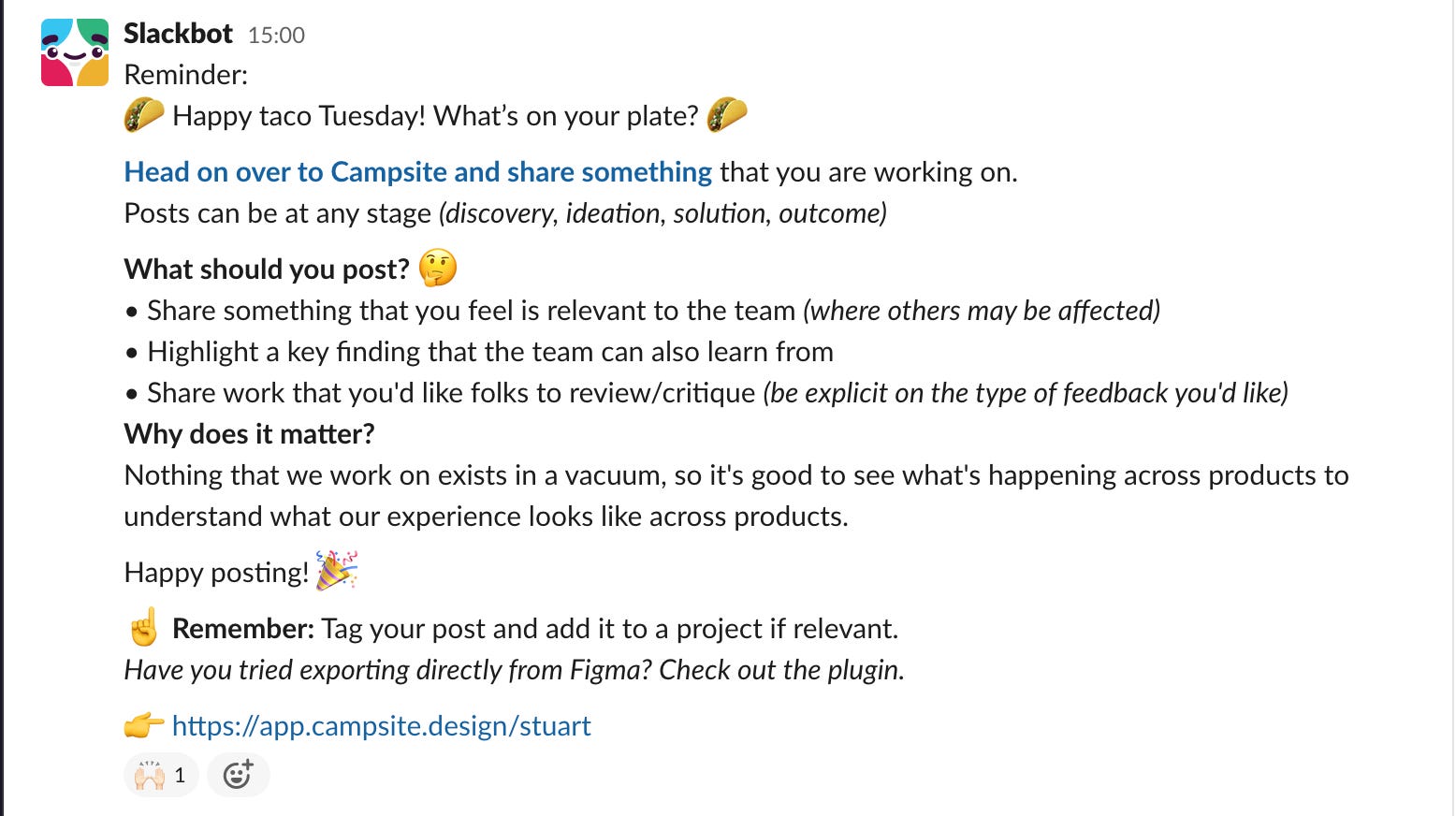
Outside of the rituals mentioned above, we had a Slackbot reminder each Tuesday to post an update on our work. Sometimes it worked, sometimes it didn't.
You see, the problem with Slack is that it's a messaging tool. I know, there are many more problems, but let's stay focused! Slack wasn't built to facilitate these types of updates in a structured way. Sure you can hack something together with a disciplined use of threads and emojis and some text formatting but it's still a hack at the end of the day.
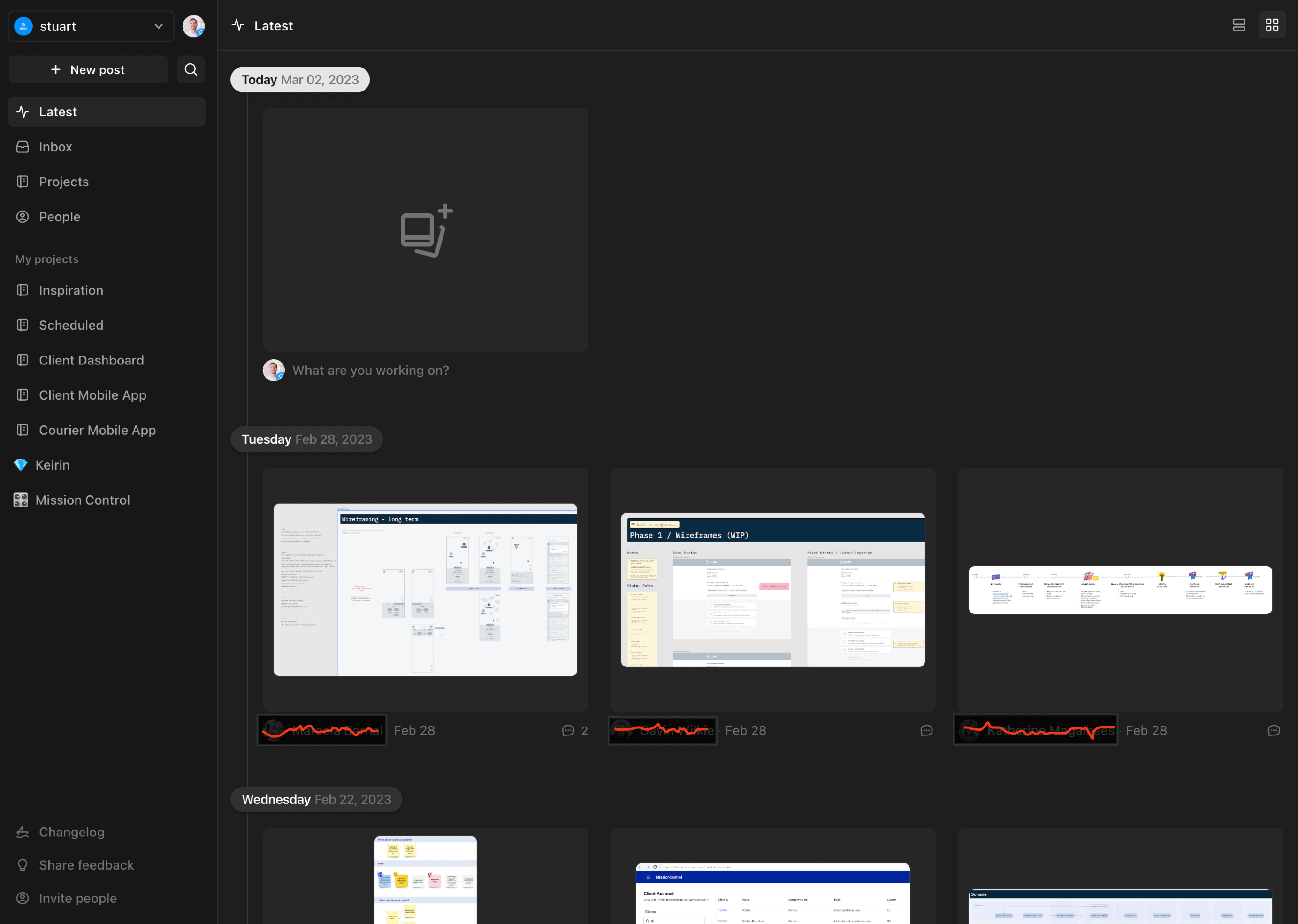
With Campsite, however, we now have a dedicated, noise-free space to say "hey, here's what's happening in my world ".
With most new things it took a bit of time to get off the ground but with some reminders set up and some positive traction the team now consistently posts updates each week which has been a great way to close the gap which was starting to form.
What we're learning
Rather than trying to make sense of what's happening in Figma by wading through files and pages and layers, Campsite gives the designers the responsibility to assess their own work and distil the important parts into a coherent narrative that can be shared with a broader audience.
This repeated practice is helping the team to progress on topics like storytelling and communication which are invaluable as a designer. Using Campsite’s Figma plug-in to post your updates helps by providing a seamless entry point to dive deeper into the work if you're interested.
Finding ways to allow the dots to connect in a more organic way is becoming key to the success of the team. Nothing happens in a vacuum and most of the time the work which the team are doing will impact others. This is a great way to try and catch those overlaps when they happen.
Closing thoughts
Whilst this has been a great way to broadcast what we're working on in a structured way, it risks us being more reactive than proactive when it comes to collaboration.
This is why we're also exploring some ways to have Product Designers and UX Researchers plan their work in such a way that we can proactively collaborate, contributing at a healthy cadence to our Product and Engineering roadmaps.
Until then, let me leave you with some general tips on keeping teams in sync:
Connect ceremonies together, considering the triggers and actions
To take an example, encouraging the team to share ahead of the weekly and critique allow us to use that space to follow up on what's happening across the teams. Sometimes, when there are no takers for the critique we can simply skim through the latest work on Campsite and see what's happening across the team in an easy-to-digest format.
Reduce barriers and friction
Setting up reminders and having clear expectations on how to share is a good starting point to get the team aligned on what can be shared and how. The reminder below was set up after some feedback from the team that they weren't 100% sure about what they should share. Note the link to Campsite is also there to make it super easy for folks to jump in and share something.
Set standards
Making sure there is enough context for someone detached from a project but not so much that it's a chore to prepare is a good balance. It's always good to celebrate the great examples from the team and to learn from each other on the different approaches we are taking when it comes to sharing updates. Reminding the team to also share their work in progress — that less-polished, unfinished state — is valuable preferred. Catching overlaps earlier will always be more cost-effective.
Keep things organised
Using Campsite's projects feature allows us to categorise work by product allowing us to see where things are converging and diverging in a particular product whilst leveraging tags for those more organic relationships. This can also be used to ping relevant Slack channels. For example, any update to our design system project will ping that relevant Slack channel helping to spread the word more broadly.
Over to you
I'd be curious to learn how you and your team tackle design at scale. Have you found any killer workflows? Feel free to reach out to me on LinkedIn if you also like to geek out on this stuff. I'd love to share stories.
Powering this week’s thoughts
Music plays such an important role when I am thinking, working, and reflecting. I also find it interesting to see what others are listening to. It's a gateway into an aspect of their personality. That's why I'd like to share, with each article, an artist or playlist that I have been listening to that week. Here's this week’s: