


The future is something which everyone reaches at the rate of 60 minutes an hour, whatever he does, whoever he is.
—C S Lewis
Ding...ding...ding. In 2022 my partner Elisa and I moved into an apartment that overlooks the old town church. Every 15 minutes, the bell tolls. Every hour, it counts the hour. Living in earshot of this iconic sound has dramatically shifted my perception of time. Being constantly reminded of it’s passing makes you far more conscious of how you are spending it.
Like money, time is something that we can spend and something that we can invest.

Open your wallet
When you look at the wallet in your pocket, it's evident if things are good or bad—but what about time? Unlike cash, this is a resource that we all hold in equal measure. Sure, we all spend it differently, but our "time wallets" are all equally stuffed with 24 hours each day.
Taking stock of our time portfolios is not an exercise that we practice as much as we do when it comes to money, but why not? Each month we may check our bank statements to see what we have spent all our hard-earned cash on. Were we smart in our spending? Did we waste it?
When was the last time you looked at how you were spending your time with the same level of scrutiny?
Invest for returns
No time spent equals no progress made. If you are not investing some amount of time with your family, or on that next project, don't expect to see any results. The first step to achieving a goal, learnings something new, mastering a craft or building a relationship all start with the same input—an investment of time.
It can be small. It can be large. That's not what matters here. What does matter is that you are taking stock and investing that time wisely with a view to that investment paying back. Saving a few pennies each day will yield a pot of cash in the future.
In revisiting James Clear's Atomic Habits, he mentions reducing a habit that you are looking to build to the smallest possible unit. He asks: "what can you do with just 2 mins?"
Taking a personal example of wanting to ride my bike more often, the act of simply leaving my gear out the night before was enough to trigger the habit the next day.
What micro-investments can you make today that will benefit your future self?
Managing your portfolio
By the time you're reading this, you have likely already invested a bunch of your time across different activities since waking up. Each day you are building up a portfolio of investments. Some yield returns and some don't—that's OK.
What's not OK is to continually invest in something with complete disregard for how it is performing. Yet, we often do this when it comes to time. When trying to get that full picture of what's happening, I recommend minimising the tools and methods you use for tracking time and tasks.
Below are some techniques that I practise using a minimal set of tools to help me manage my time.
Keep your receipts
Your bank will often oblige in sending you some sort of monthly statement to help you keep on top of your finances. When it comes to time though, that's on you. Why not set a reminder on your calendar to dig through those receipts and check your balance? What did you spend today? This week? This month? Was it reckless spending, or sensible?
Personally, I used to set time aside to reflect at the end of each week but I would often forget the details of my spending throughout the week. With my shortlist of tools and techniques, I'm able to easily track this balance.
Check the stocks
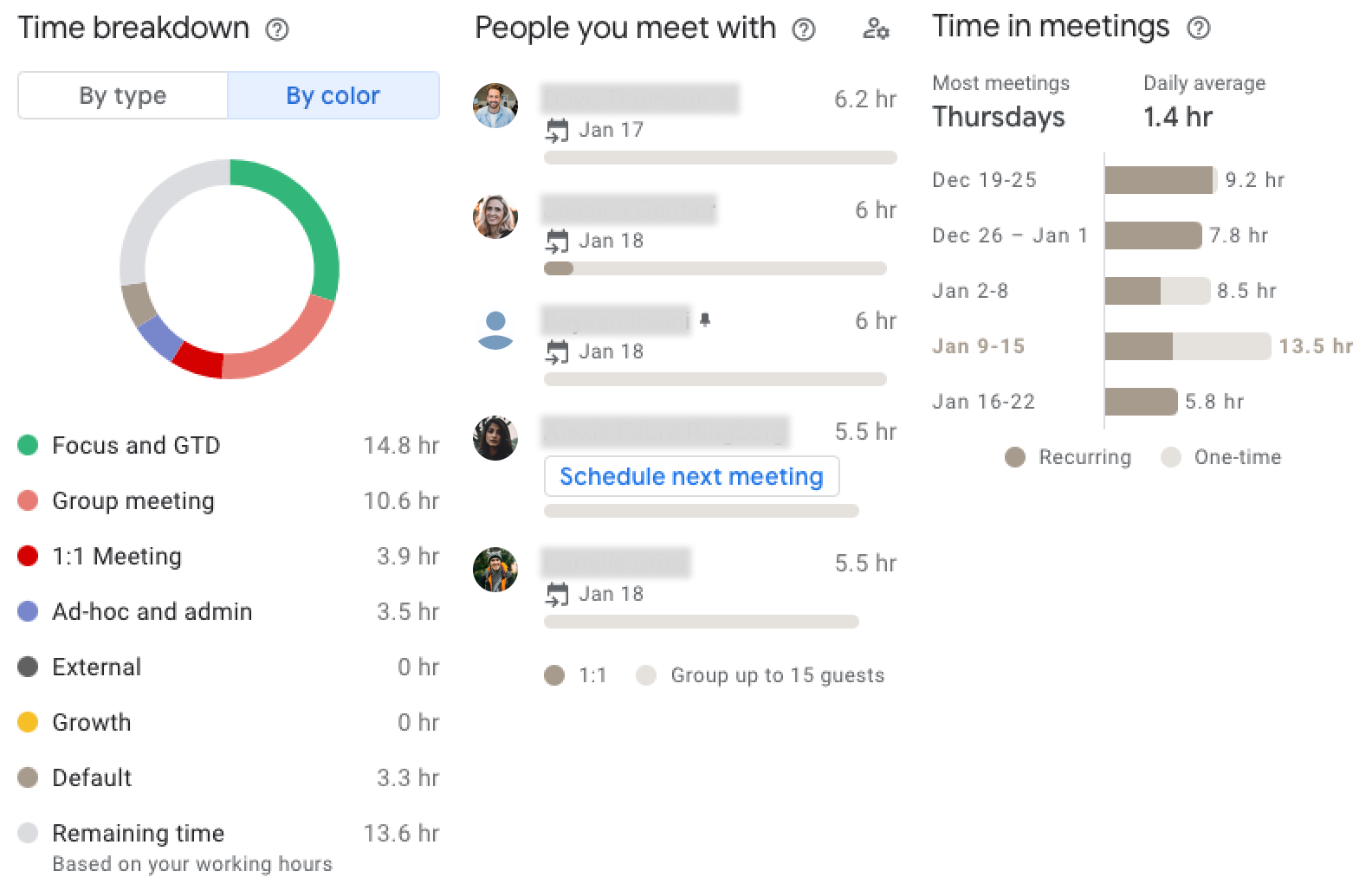
Back in 2021, Google launched its new "time insights" feature which has been a great addition to their product. If you are using your calendar for meetings and to track personal things, this feature can be a great way to keep a finger on the pulse and spot any trends.
Look ahead
So, we've looked back and reflected on where our time is going, but what about the future? It's just as important to keep an eye on this perspective when looking at your time investments.
It may sound simple, but taking a moment to look at my day or week ahead has been a real game-changer. If you can see that you are running low on time, you can proactively shuffle around some meetings or simply opt out altogether.
You may also spot something towards the end of the week which actually requires some upfront investment. Do you have that blocked in your calendar? Being more mindful of what's to come has really helped me to take back control of my calendar, and my time. Why not try it right now? Take a look at the rest of your week and see what you find.
Hire some help
When I was younger, paying for anything other than food and shelter seemed frivolous. Why pay someone to fix my bike when I can get out the tools and do it myself? The reality was that sometimes I would get stuck for 60 minutes trying to change a tyre—not the best use of my precious time. At some point, you realise that it may make more sense to hire some help.
This is true for many things in life, and it's why I use Reclaim.ai to help manage my calendar. Though there are paid plans, you can also use Reclaim for free, which is still pretty powerful. You can use it to protect blocks of time in your calendar and like a trusty assistant it will also do all the shuffling for you while making sure you still have time for what you need. Go check it out.
Bundle your (time) budgets
In this ever-distracting world, there is no shortage of things out there which are demanding our attention and begging us to switch contexts. Don't contribute to the problem. As I mentioned in my previous article on meetings done right, I like to bundle contextually related meetings together.
For example, on Friday afternoons, I have a couple of leadership meetings with folks in our tech team. Given these meetings would be a space to raise issues or address big topics, it made sense for me to sync with my reports earlier that same day. This way, in the mornings I can stay focused on listening to the team during our 1:1's and capture any key points that can then be fed into the meetings later that same day.
This way, one activity feeds directly into the other, in succession. No need to stop and start and risk forgetting some key points that were made. My mind is already primed with potential talking points to take into that next meeting.
Maintain focus
Lastly, when you do have those in-between moments or even the long stretches, one technique that I have found to work well is to hold myself accountable for completing certain tasks within a specific time. For this I also use TickTick. Simply seeing a timer counting away in my status bar is a subtle, but effective, reminder not to stray off-course and to commit to finishing what I set out to do.
I've been using this feature for years, which has always worked great. Now, though, those chunks of time that you track also show up in your calendar, like mini time receipts. This is a great way for you to look back and reflect on where your time was spent.
Wrapping up
We've covered a lot of ground and I've only scratched the surface. I'd like to follow up with a more in-depth view of how I use some of these tools together with examples.
Thanks for reading. Now, go invest some of that time wisely!
Powering this week’s thoughts
Music plays such an important role when I am thinking, working, and reflecting. I also find it interesting to see what others are listening to. It's a gateway into their interests and personality. That's why I'd like to share, with each article, an artist or playlist that I have been listening to that week. Here's what’s powering this week: