


When I lived in Edinburgh I used to go to Jiu-Jitsu twice a week. It was great fun and will probably be the most flexible I have ever been in my life — oh the joys of ageing. Anyway, during those cold, dark nights, I learned about the art of using an opponent’s force against them. It unlocked a whole new perspective on how to deal with any adversaries you came across in life.
After working with tech for more than 2 decades, I've learned that you can apply the same principles when facing off against digital bullies. You can use their distracting blows to your advantage.
Trigger future conversations
I’m sure it’s familiar to you also…you have a chat with someone, discuss some follow-up steps or ideas and then fail to ever do so. It’s normal. We can often be overwhelmed juggling many things that it’s easy to forget. Sure, I could create a task and follow up on that, but I often find myself looking at those tasks while scratching my head. What did I mean by that? The context is lost.
Rather than capturing a task and following up on it later in the day, week or — dare I say — month, why not just start the conversation today?
Here are a couple of use cases where I have used Slack’s scheduled message feature to make this tool work for me and not against me.
Out-of-office 1:1s
Just because I may be heading out for a long weekend doesn’t mean that I give less f*cks about my team. Whilst I might be sipping on a chilled glass of something on a Friday afternoon, they may still be slogging away, wrapping up their work week.
As part of my ritual before signing off for a holiday where I know I will miss a bunch of 1:1s with my team, I line up some check-ins that are sent out during the time we would normally meet.
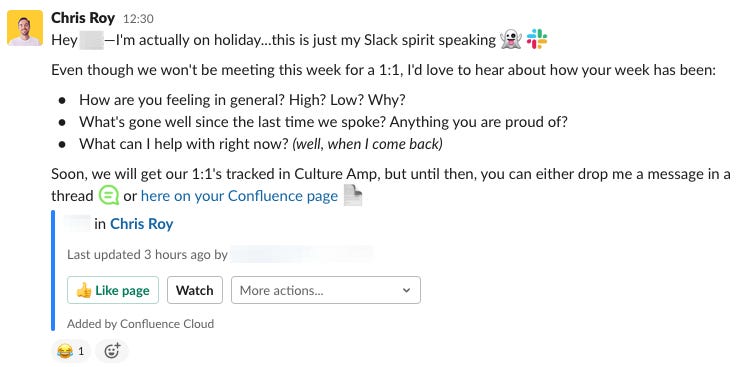
I must say, I was pretty thrilled to see this brought a moment of joy to them that day. What’s more, I was able to come back the following week with some context that would have otherwise been lost.
You see our brains are terrible at recalling emotions and memories as more time passes. So, had I come back and asked “How was last week?” it would likely get a much more diluted response than capturing someone at that moment at the end of their week.
Project follow-ups
To take another example, the other day I had a call with someone from my team to talk through a complex project that was coming up. I made a point during the call to ask for some specific dates when the next steps were planned. After the call, I jumped immediately into Slack (with the conversation fresh in my head) and began to type a future check-in message.
It went something like this:
[Project name]
Hey — good morning. I set up this little reminder after our chat on Tuesday. You mentioned that you should be finishing up with [stage X] yesterday.As a recap, we discussed two key things to start looking at today:
[Thing 1]
[Thing 2]
Did you manage to complete [blocking task]?
Let me know if I can help with anything and let's aim to review the work in progress at the end of this week.
I realised one thing writing this in Slack vs capturing it as a to-do made it feel like I was writing to that person. This immediately adds a level of writing standard that is all too easy to ignore when capturing tasks for yourself. It was far more articulate and relevant as I captured the key context immediately after our discussion.
In task form, it would have looked something like: “Catch up with [person] on [thing]”. Once that day rolled around I would likely look at that task and wondered what the hell we spoke about and maybe fail to follow up as a result.
Learning the “killer” move
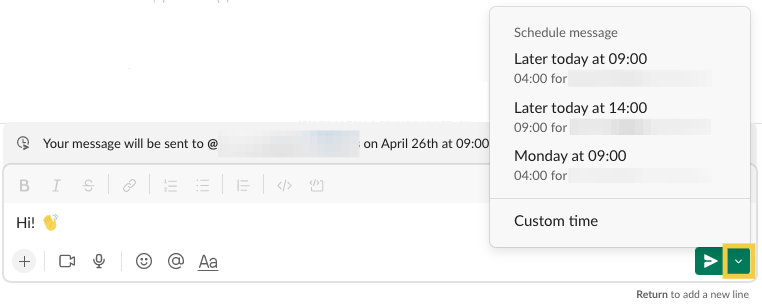
If you would like to use automated reminders and queue up conversations like a robot, but with the goal of being more human and staying connected even if you are absent, here’s how to get started:
Simply draft your message to someone when it’s relevant and you have the context
Do a quick proof-read and make sure you don’t land your future self in trouble
Click the schedule button
Choose an appropriate time for the Slack spirit version of you to reappear 👻
Powering this week’s thoughts
Music plays such an important role when I am thinking, working, and reflecting. I also find it interesting to see what others are listening to.
It's a gateway into an aspect of their personality. That's why I'd like to share, with each article, an artist or playlist that I have been listening to that week.