


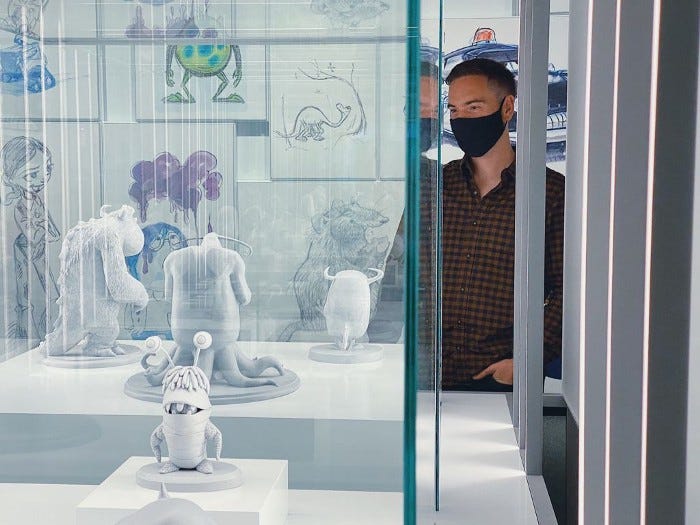
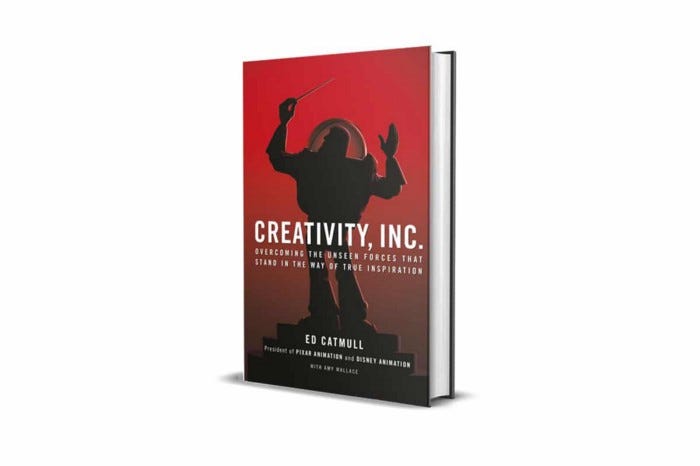
One thing I have never excelled at is reading books from cover to cover. With 2020 in lockdown, I used the apartment-bound time to work on that. Here, I share my summary of one of my favourite reads of 2020—Creativity, Inc.
This article dips into some of the key chapters and themes of the book and highlights my key takeaways in light of being a manager and an executive. I hope this can also provide some takeaways for your day-to-day, and if you enjoy it, I’d highly encourage you to head out and buy the book!
It starts with the team
Seems obvious, right? It baffles me to hear so many horror stories and to have worked in some teams that just weren’t well designed. That being said, getting the team right is not easy—but undeniably important.
“Getting the team right is the necessary precursor to getting the ideas right.”
—Ed Catmull
First, align on your principles
One way of building cohesion in the team is to develop shared principles that everyone aligns with. What is acceptable? What is not? Starting here ensures that the team is on the same page about what matters, and what they collectively stand for.
In an example given, the team working on Toy Story 2 was suggested to go straight to video. This was against the principles they’d set out, so they premiered in theatres and with great success.
In addition to having strong principles, a sub-group of employees got together and formed “the Braintrust”. This was an organically formed group of talented folks who would diagnose early iterations and give candid feedback where it was needed.
Because this was formed from the bottom and not pushed down by leadership, it worked. This team took the principles and wove them into regular ceremonies where they could continually raise the bar of the work they did.
“Ideas come from people. Therefore, people are more important than ideas.”
—Ed Catmull
Be accountable
The team at Pixar was given space and all shared a great connection through the work they did. One interesting acknowledgement was that leaders should focus more on how the team is performing instead of individual talents. Whilst I agree that team performance is important, I see that it could also obscure individual problems within the team.
When you focus on individuals, you may find that you need to let people go. As a hiring manager, you have the responsibility to protect and grow the team's culture. So, rather than blindly hanging on to bad apples or poor fits, sometimes it’s best to let them go—for both sides. This is never easy. But as a leader, it demonstrates your conviction in the principles and wider culture.
When you can lead by example and pull the chord when part of the system is not working you encourage, by showing others, that it’s OK to highlight when something is not working.
“If you give a mediocre idea to a brilliant team, they will either fix it or throw it away and come up with something better.”
—Ed Catmull
Establish a “red circle”
One thing that stuck with me which I have used with new hires is an anecdote that was told from the production line of Toyota. Basically, when a new factory floor worker completes their first week, they are asked to stand in a circle where they are not allowed to leave until they announce at least three things that could be improved.
It stems from the idea that executives and those making all the decisions can become so unaware of what happens “on the floor”. Giving this space to new workers to call out failures or inefficiencies in the process fosters a culture of radical candor and transparency. Everyone owns and can affect the process.
In my personal experience, I often end weeklies or 1:1’s by asking what we can be doing better. When unasked, issues go unsaid. Through continuously asking and building that trust with the team, I have been able to act on the feedback and make continuous improvements for my teams.
“Making the process better, easier, and cheaper is an important aspiration, something we continually work on—but it is not the goal. Making something great is the goal.”
—Ed Catmull
What’s a team without trust?
Continuing with the idea of trust, across the board, this is also something key at Pixar and something I have come to value — a lot.
Honesty vs candor
One thing to clarify in this section is the difference between honesty and candor. Honesty, in the book, is described as often carrying baggage and can sometimes have a negative impact.
If I was to tell someone—honestly—that “you look tired”, the delivery might seem brutal. If framed candidly to say that “you have not been working to your usual high standards, perhaps you need some rest” demonstrates a frankness that also takes into account that person's well-being. If you’ve not already read it, I highly suggest checking out Radical Candor.
Having personally come from a place where I would try to avoid difficult conversations to one where I openly welcome them was a big shift. I knew that it would be. What I didn’t know was how refreshing it can be to exercise that level of trust with each other, where you can be sure that everything is shared with the best interests at heart.
“[In the Braintrust, they] do not prescribe how to fix the problem — they diagnose.”
—Ed Catmull
Failing to define failure
When we talk about failure, it is often accompanied by a sour taste in our mouths. From a very young age, we are taught that failure is bad. It implies you didn’t study enough or pay attention at school.
However, failure also implies that you tried. Even though you may not have been fully prepared, you took a shot, and hopefully, you learned something along the way. This is the true value in failure—it’s an inevitable step in finding originality.
As I get older and observe my infant nieces growing up, I am reminded how beautiful the mind is at that age. Before being burdened with social expectations and adult responsibilities, they are free to think and act as they see fit at that moment. Sometimes it leads to a beautiful creation. Sometimes not. The notable thing is that it was tried without hesitation or fear of failure.
When the desire to avoid failure is so strong, it forces us to stay within our comfort zones. This will often lead to mediocre ideas and an unfulfilled life.
“Get a bike that’s…low to the ground…put on elbow and knee pads so you’re not afraid of falling, and go.”
—Andrew Stanton
Of beasts and babies
Let’s kick off with some terminology—the “beast” is the release schedule. It is the momentum that drives everything forward and it needs to be fed. The beast can be dangerous though. In satiating its needs, it can be hard to find that creative space that is needed. Creativity is not an on-demand thing and works counter to the beast.
Creations cultivated between the gaps of feeding the beast are referred to as the “ugly babies”. This manages the expectation that in their infancy they cannot live up to the promise of more mature and formed ideas.
A butterfly is born from the less appealing caterpillar which needs to lay protected in its cocoon long enough to form. Creative ideas need that same protection. They need that space and that time to grow into something potentially beautiful. But it’s not guaranteed. Sometimes those babies remain ugly and they need to be left like that—it’s OK. Not everything is worth protecting and investing in, but it should be given the space to try.
With this analogy in mind, it’s worth noting that the beast is not all that is bad, and the baby all that is good. We need the beast to keep us motivated and challenged. The baby, though full of potential, can also keep us up at night and be needy—demanding our time and energy.
In trying to describe how to find the balance between the two, the author states that the practice is akin to trying to stand on a balancing board. No matter how many books you read about it, or how much training you were given, the best way to figure it out is by getting on the board. Let the conscious and subconscious figure it out—you need to learn by doing.
Change is inevitable
Words are powerful and carry weight. So be careful with them. This chapter cautions against making a false promise that things will never change. After the acquisition of Pixar by Disney, the author mentions that their culture and the good parts of the company would stay the same. However, after the merger, people gawked at his previous comment when things, inevitably, changed.
Growth and success require change. Change is not bad and needs to be embraced. As humans, we can sometimes act like children playing musical chairs. We clutch onto the previous chair as our safe space. We don’t want to risk being left behind. This fear to embrace change and opening up can seriously impede us from moving forward.
It is a far smarter strategy to change course when new information comes to light or when external factors change. It would be foolish to defiantly stand your ground when everything signals you to make a change.
Problems arise as a natural part of life. Big problems and small ones. The big ones notably shake us up more than the smaller ones but one thing that’s known is that there will always be some sort of problem to deal with. We just need to be open and mentally ready to face the problems rather than freaking out when something goes awry.
No space for blame
He recalls one moment during the making of Toy Story 2 when all of the files were wiped from the central system. On top of this, the backup recovery was not possible as there had been an issue with that too. Luckily, a new mother had been saving local copies to her personal computer to allow her to work from home so that she could spend more time with her newborn. They rushed to get the machine from her house and copied those files back to the central system.
Following such a potentially catastrophic event it would have been easy to start pointing fingers. Instead, these three things happened:
They restored the film and all of its related files
They fixed the backup system having found out it was flawed
They installed precautionary systems to prevent something similar from happening again in the future
Note how none of the steps were to identify who was responsible for losing the files in the first place. Why? Because people have good intentions. To single someone out for wrongdoing when it was likely a random error or mistake is an unfair approach.
When meltdowns like this occur, it is a great opportunity for managers to demonstrate the compani’s core values and lead by example.
A final point that resonated was the author’s comment on how he’d hear people around the company asking things like:
“What would Walt (Disney) do?”
or
“What would Steve (Jobs) do?”
In approaching your problem-solving this way you are looking at what used to work in the past. Understand that situations, contexts, and environments will always differ. Use your best judgment based on all that you know to decide at that moment.

Seeing what’s hidden
Starting with an anecdote, this section explores the story of Cassandra, daughter of the King of Troy and partner to the Greek god of poetry, Apollo.
After being put under a curse after betraying her partner, it is said that every word she says will be heard as a lie. When trying to warn of the impending attack on Troy by the Trojan horse, no one believed her.
However, it was not Cassandra who was cursed, but the people who could not perceive the truth that she spoke.
Are there any Cassandra’s in our life that we are not listening to?
Cultural quietness
As companies evolve and hierarchy appears, it can be all too common that colleagues, especially reports, only bubble up what they want their managers to hear—not necessarily what they should hear.
With this self-preservation mindset, it can become easy to feel overwhelmed with the “success” of the team and become blind to the unseen—the things which are selectively not shared. This can be very dangerous.
Whilst we must accept that we cannot, and should not, know absolutely everything that’s happening, your team must be empowered and encouraged to share what’s needed. Processes and culture should encourage the people at the front lines—the ones with the clearest views of the fires—to come forward and make the fires known.
It can be easy to lose sight of this need though, so I would always encourage you to continue asking how things are going, and what needs improving. Don’t let people leave an important ceremony until they share at least one thing that needs to be improved, because we all know that nothing can be perfect all of the time.
“Lest we be like the cat that sits down on a hot stove-lid. She will never sit down on a hot stove-lid again — and that is all well; but also, she will never sit down on a cold one anymore.”
—Mark Twain
Broadening our view
To maximize each team member's input, the team at Pixar had several ceremonies that they would use to align and gather feedback. Here’s a highlight of these:
Dailies—where the team could solve problems together
This is a safe space where people can leave specific feedback and critique each other openly. It was a chance for people to see and hear how others thought and how they approached problem-solving.
In my experience, with something like dailies or any sort of critique, you should always set out by first establishing what “the rules” are. A typical example could be to state that the sessions are not to find new solutions but to simply diagnose what’s not working and then allow the respective team members to go off and process that feedback.
Having some sort of guardrail in place will help keep these sessions focused and efficient. It’s also a great way to continue practicing candor within the team and ensuring a trusted, and communicative environment.
When embarrassment goes away, people become more creative.
Research trips
On walking into a war room in Disney where the directors had pinned up works and inspiration, the author noted that it seemed terribly derivative. In only having a view of the world by taking inspiration from creations of before, we are at risk of “Frankensteining”, he noted.
The risk here in approaching research and inspiration in this fashion is that we create the illusion of creativity but we lack the craft. We subconsciously connect disparate works from others to arrive at an idea that is simply a bastardization of other people's works amalgamated into one.
To think beyond what we “know” (or that which we subconsciously see) we have to get out of the building and do some real research. As an example: when creating Ratatouille, the crew spent two weeks dining in Parisienne Michelin-starred restaurants and wading through the city’s sewers.
Whilst I am not advocating for you to submerge yourself, knee-deep, in Paris’ wastewater, I would always recommend getting out there and challenging your perceptions. Whether that’s customers, human behaviors, or environmental factors.
You’ll never stumble upon the unexpected if you stick to the familiar.
The power of limits
Limits can often feel restrictive and oppressive. But this is often just our perception. Having limits allows us to challenge our creativity in new and effective ways.
In an example given, an artist had spent weeks crafting the shading algorithm for a set of CDs that would come crashing down in Sully’s apartment in the film Monsters Inc. Only a few of the CDs were seen, and only for a second or two, but the love and craft that went into them was obsessive.
Brad Bird, one of the directors, coined a term in movie-making called “mirages” where someone becomes obsessed over a scene or an idea that does not serve the film, but they become attached and invest endless amounts of wasteful time on it.
It can be dangerous to develop a culture that believes more always equals more
Integrating technology and art
At Pixar, art and technology understandably overlap and weave in and out of one another. Whilst this can be frustrating to blend the left and the right sides of the brain, it can also pave the way for new solutions when challenged.
For example, Brad Bird was growing frustrated at the imprecision and inefficiencies of giving verbal feedback to animators. In posing the question, the software department got to work and created the “Review Sketch” tool. This gave directors a digital stylus that they could use to draw directly on top of an image.
Following this, software engineers and artists worked together on “Pitch Doctor”. A tool that would allow early pitches and storyboards to be easily re-ordered and re-submitted based on early feedback.
“Art challenged technology, technology inspires art.”
—John Lassater
Short experiments
If you’ve not already seen one, it’s worth checking out some of Pixar's short movies. With costs up to $2M, one could ask why the company is prepared to make such an investment in what could be seen as a frivolous experiment.
In a lot of companies, you must justify the work that you do. This does not always make sense to deliver the best ideas. Consider science experiments—you don’t know if you will achieve a breakthrough when you set out, but that doesn’t stop them from happening.
In budgeting for the shorts, Pixar was able to demonstrate its dedication to creativity and the result of experimenting on these smaller productions meant that the smaller team could learn a wider range of skills that would later serve the bigger productions. It was an investment of sorts, but one which was willing to fail.
A testament to this approach was demonstrated when a talented children’s book author wanted to create a feature but instead was placed on a short. What the team realized (after seeing the 12-minute short) was that they could not focus on a spine for the story. It lacked emotion and punch. It was costly, but it was a mistake that could be learned from without the investment of a full feature-length film.
“Better to have train wrecks with miniature trains than with real ones.”
—Joe Ranft
Learning to see
Probably one of my favorite sections of the book was this one. It made me question how I see the world and how differently that may look to others. It can be so easy to overlook the biases which we all have.
When we draw, we are constantly balancing the left and right brain. The verbal, and analytical left part of the brain has to be silenced for us to draw that which we truly see.
If not, we risk leaning on experience and biases and drawing things as we believe they are, or should be. For example, if asked to draw a table, my version of that may look very different to someone who has lived in rural Mongolia.
An interesting trick that art teachers will often use is to place objects upside down when drawing them or ask students to draw the negative space instead of the object. This forces our brain to drop our preconceived notions and see things in new ways. This is where we can really start to “see” things for what they are and challenge our biases.
This is an activity that I try to practice regularly, which often results in me visually, or physically, deconstructing things to better understand how they connect and what composite parts make up the whole.
Postmortems
For those unfamiliar, a postmortem is an exercise to consolidate learnings at the end of a project. You see, people, and companies, become exceptional not by believing they are so, but instead by identifying ways in which they are not. This gives us an understanding of where we need to grow.
Post mortems, however, can often elicit negative reactions as we can often be uncomfortable in the act of highlighting failures or second-guessing ourselves. Once practiced though, they allow you to move forward, stronger than before. Surely that’s a good thing.
In the book, 5 key steps are defined, as follows:
Consolidate what’s been learned
This is a way to reflect and share key points of what each person on the project has learned.Teach others who weren’t there
They open the lid and offer others a way to learn from our successes or failures to apply or avoid in their own projects.Don’t let resentments fester
Rather than sit on misunderstandings or genuine mistakes, it’s best to get them out, deal with them and move on. Otherwise, they can linger and affect future work.Use the schedule to force reflection
They can help us to think and evaluate. Scheduling the meeting forces people to reflect and consider what worked and what didn’t. An activity that could easily go on unchecked otherwise.Pay it forward
It helps to arm us with questions to ask on the next project based on learnings from the past one. How can we better prepare?
A post-mortem is simply a data-gathering exercise that can be referred to and acted upon. Data, though, is just one way of seeing. Some people try and avoid it, while others live and die by its “insights”. The truth is that either extreme can lead to false conclusions.
“Data can be nothing less than soothing.”
—Lindsey Collins
An oft-used phrase in business is that you can’t manage that which you can’t measure. This is a flawed perspective though as it does not respect that which is hidden. Post mortems will not expose everything, but hopefully enough for you to improve moving forward.
Continuing to learn
In establishing the Pixar University, where the team could share and learn from one another, one thing that was observed was that when they extended classes to include more abstract disciplines like sculpting, meditation, belly dancing, and much more they realized that a new value was created through having the different disciplines sat next to one another. As there was no hierarchy here, conversation flowed.
When we start in life, as children, we need to be open to learning as most of the things which we encounter we have never seen before. So why then, when we turn into adults, do we fear surprises and seek to control all outcomes? This is a point that I find interesting and again try to challenge myself on. It’s all too comfortable to stick to what you know and never grow from there.
In companies, when moving from the startup mentality where we often exhibit a beginner's mind, we can easily fall into the trap of repeating what we have done before as we seek to replicate success.
We must try and keep hold of those earlier risks that we were willing to take to drive creativity and innovation forward.
The unmade future
Looking ahead can be frightening. It is an open abyss that we cannot fully understand as it has not yet happened. But let’s not allow that to prevent us from stepping forward and being a part of its creation.
“The best way to predict the future is to invent it.”
—Alan Kay
In reflecting on one of his ski trips Brad Bird recalled how he kept falling when he was trying to ski. He was trying too hard. When he let go and relaxed he began to ski better. The same can be said of creativity. When we set out to find it, and try too hard, it may never appear. Just relax, open up, and set off on a path and see if you stumble across it.
We can often be our own worst enemies in the pursuit of perfection. It can be intimidating and overwhelming. We should favor being decisive over being correct. Being decisive will allow us to know quickly if we were correct or not.
Another way to step forward in creating the future is to invite people into your problems—not just your solutions. In opening up and humbly sharing earlier stages, people will be more likely to trust you. People want to know when you f*cked up too—it’s an equalizer. It will also ensure that you don’t get too attached to your early works—remember the babies from earlier? Sometimes you just need to let go, and it’s best to know that earlier rather than later.
Extending on the point of having your team trust you, a comment about management that resonated with me was the idea that when you are a manager, each of your employees has their own floor in a hypothetical building. Some people live up high, on the top floors. Others on street level. As a manager, it is your job to ride the elevator and see the world from their perspectives.
“You must meet them where they live.”
—Katharine Sarafian
To finish
A fitting chapter to end on is that which describes “Notes day”. An exercise that asked for the company to reflect and improve after the merger with Disney.
The company was facing three distinct problems that it wanted to address. Due to the success of Pixar, it became very easy for the veterans to feel entitled in their position within a successful company and overlook areas that were perhaps not working.
The same was true for new employees. They would arrive at the company and believe that they would have nothing to offer in the way of feedback to this well-oiled machine. Their successes had led to less feedback—and this was not OK.
The key takeaway from this chapter, and much of the book if you have not already gathered, is that we need to stay true to the fact that change is inevitable and that we must adapt. We must stay curious and continue to question our ways.
John, one of the executives, expected a single page of notes from the exercise. He ended up with two and a half. Standing in front of the company, he reminded them all of the importance of candor and then went on to share some of the key feedback—a lot of which was directed to him.
It was hard to swallow, but it was necessary. It was leading by example. Showing your team the importance of candor and more importantly how to act on the feedback that you receive shows true leadership and inspires others to act in the same way.
“The future is not a destination. It’s a direction.”
— Ed Catmull
If you have any feedback or comments, I’d love to hear them via the comments below 💬